


AES brand guidelines
AES' style guide
Introduction
When we work All together as one team, we have proven that we make a greater impact to our purpose of improving lives by delivering the smarter, greener energy solutions the world needs.
This is why it is more important than ever to communicate consistently – internally and externally
as one AES
Outcomes you can expect
AES’ Style Guide serves as a complement to our brand guidelines and will help you to write clear, consistent, and on-brand content across all teams and channels. It goes beyond basic grammar and style points to get to the root of who we are and what we want to communicate to all of our stakeholders.
By the end of this guide, you will have a better understanding of how to:
Consistently create on-brand content that accurately reflect who AES is and how we work.
Communicate effectively with all stakeholder groups by speaking in our company’s unique and research-backed language.
Describe your market, team, energy projects, and initiatives using the AES masterbrand model.
Understand the nitty gritty formatting and grammatical details of our style – from how to add emphasis to text to when to use decimal points.
Highlight our customers and innovative projects in a way that shows both the leadership of our partners and AES.
Write confidently in AES’ style and tone of voice and reduce content approval time!
Make a positive impact on AES’ strategy and goals by unifying your team’s unique work to our shared purpose.
AES follows the Associated Press (AP) Stylebook.
Additional free resources on AP Style can be found here.
AES house style
While the AP Stylebook provides a great reference point for basic grammar rules, AES makes some exceptions to the rules for the sake of branding, tone, and style. In the following sections, you’ll find the exceptions to the house style rules plus AES-specific rules that frequently come up when writing about us.
Spelling
carbon-free energy
Not carbon free energy
Exception
We use the term zero-carbon energy only when talking about agreements with Microsoft.
lithium-ion
Not lithium ion, Lithium-Ion, or Li-ion
net-zero
Not net zero
power purchase agreement (PPA)
Not Power Purchase Agreement
solar-plus-storage, solar + storage or solar and storage
Not solar plus storage or solar/storage
US (when abbreviating United States)
Not U.S.
Terms
AES people
Not AES employees
Customers
Not clients or off-takers
Energy facilities
Yes
- energy project
- power plant
- facility
- "[energy type] + [plant/project/facility]" (e.g. solar plant, wind project, hydro facility)
No
- generation facility, generation plant
- powerplant
- asset
- solar PV plant or PV solar plant
Energy terms
Format kilowatt (kW), megawatt (MW), and gigawatt (GW) as “[#] + [abbreviation]” with a space between the number and measurement.
There is no need to spell out the term (e.g. megawatt) since these are common industry terms and used daily at AES.
Yes
- kW or kWh, MW or MWh, GW or GWh
- 50 kWh
- 101 MW
- 12 GW
No
- 50kWh
- 101MW
- 12GW
Adhering to certain rules of grammar and mechanics helps us keep our writing clear and consistent. This section will lay out our house style, which applies to all of our content unless otherwise noted in this guide.
Some of these items are in line with AP Style, but we have included for emphasis.
Abbreviations and acronyms
If there’s a chance your reader won’t recognize an abbreviation or acronym, spell it out the first time you mention it. Then, use the short version for all other references. If the abbreviation isn’t clearly related to the full version, specify in parentheses.
- First use: Performance Monitoring & Analytics Center (PMAC)
- Second use: PMAC
If the abbreviation or acronym is well known to the target audience (e.g., MW or kWh) use the abbreviation in all instances. There is no need to spell out the full term first.
Ampersands
Don't use ampersands unless one is part of a company, product, or brand name.
YES
- Performance Monitoring & Analytics Center
- Mary and Miguel
NO
- Mary & Miguel
Apostrophes
The apostrophe’s most common use is making a word possessive. If the word already ends in an “s”, whether it is singular or plural, just add an apostrophe.
YES
- AES’ vision for a greener energy future.
- Chris’ presentation at the conference.
NO
- AES’s vision for a greener energy future.
- Chris’s presentation at the conference.
Backslash (“/”)
AES does not use a backslash (“/”) to separate thoughts, sentences, or clauses in communications. This is because a “/” gives the appearance that a piece of content is still in draft form as opposed to a polished, finalized piece.
Instead, turn the text into a complete sentence. Or, use semicolons or commas to separate statements as appropriate.
YES
Meet with a hiring manager to discuss salary and benefits at AES.
NO
- Meet with a hiring manager to discuss salary / benefits at AES.
Bold
See “Graphics and formatting” for guidelines on how to emphasize text.
Commas
As an exception to AP Style, use the Oxford comma when listing items.
Use commas for introductory clauses.
YES
- We deliver reliable, affordable, and clean energy.
- This week, AES Brasil planted 14 new native plant species as part of the team’s biodiversity initiative.
NO
- We deliver reliable, affordable and clean energy.
- This week AES Brasil planted 14 new native plants as part of the team's biodiversity initiative.
Capitalization
AES uses sentence case for document titles, headings, and product names, and when referring to our values.
YES
- Challenging the status quo.
- Safety first, Highest standards, All together
NO
- Challenge the Status Quo.
- Safety First or safety first.
Do not capitalize energy facility types (e.g. solar plant, wind farm). For AES projects, only the project name is capitalized.
YES
- AES Bulgaria’s St. Nikola wind farm
- AES Brasil Tucano wind complex
- AES Chile Andes IIB solar plant
- Lawai solar-plus-storage project
- Luna energy storage facility
NO
- AES Bulgaria St. Nikola Wind Farm
- AES Brasil Tucano Wind Complex
- AES Chile Andes IIB Solar Plant
- Lawai Solar-Plus-Storage Project
- Luna Energy Storage facility
Cities, states, provinces, and countries
Spell out city and state names. Don’t abbreviate city names.
YES
- Riverside, California
- Los Angeles, California
NO
- Riverside, CA
- LA, California
On first mention, write out “United States”. On subsequent mentions, “US” is OK. The same rule applies to any other country or federation with a common abbreviation (e.g. European Union, EU; United Kingdom, UK).
Colons
A colon or em dash is appropriate to offset a list within a paragraph. Do not use parentheses “()”.
YES
- Henry ordered three kinds of donuts: glazed, chocolate, and pumpkin.
- Henry ordered three kinds of donuts – glazed, chocolate, and pumpkin.
NO
Henry ordered three kinds of donuts (glazed, chocolate, and pumpkin).
Do not use colons unless text immediately follows the colon.
For headers, labels and subheaders: AES uses a paragraph break after a header. A colon should not be used after a header or label.
YES
- AES in 2050
Our strategy for the future is founded in three key areas.
NO
- AES in 2050:
Our strategy for the future is founded in three key areas.
Decimals
Do not include decimals in figures. Jump to “Numbers: Counting, rounding” for best practices on rounding numbers.
Em dash
An em dash or colon is appropriate to offset a list or an aside. Use an em dash “—" to offset an aside. Use a true em dash, not hyphens: “-“ or “--".
YES
- Jordan ordered three kinds of donuts – glazed, chocolate, and pumpkin.
- Jordan ordered three kinds of donuts: glazed, chocolate, and pumpkin.
NO
- Jordan ordered three kinds of donuts (glazed, chocolate, and pumpkin).
Italics
Industry publications are italicized.
YES
- According to the article in Power Engineering...
- Forbes “Green Growth 50” list.
NO
- According to the article in Power Engineering...
- Forbes “Green Growth 50” list.
See “Graphics and formatting” for guidelines on how to emphasize text.
Fractions
Use numerical values instead of spelling out fractions.
YES
2/3
NO
- Two-thirds
Lists (bulleted)
Each statement in a bulleted list group should end with the same punctuation. This means being consistent using or omitting periods after each bulleted statement.
Parentheses or ellipses
AES rarely uses parentheses. We incorporate information directly into copy.
YES
- To view the Pride merchandise, visit the AES Store and enter the search term “Pride”.
- Visit the AES EAP website to learn more tips for moving on after an argument. The guest login is “aes”.
NO
- To view the Pride merchandise, visit the AES Store (search word “Pride”).
- Visit the AES EAP website to learn more tips for moving on after an argument. (The guest login is: aes.)
Do not put dates in parentheses.
YES
- On June 16, Indiana Business Journal reported the Indiana Utility Commission “approved a deal by AES Indiana” to build a large solar farm in Clinton County.
NO
- Indiana Business Journal reported (June 16) the Indiana Utility Commission “approved a deal by AES Indiana” to build a large solar farm in Clinton County.
Quotation marks
Names of awards or recognitions should be in quotations.
YES
AES was named to the “Top 100 Workplaces in 2022” ranking by Best Workplaces.
NO
- AES was named to the Top 100 Workplaces in 2022 ranking by Best Workplaces.
Money
When writing about currency, use the appropriate currency symbol before the amount. Round to the nearest ten value. Do not include decimals.
YES
$15,780 donation
NO
- $15,781.14 donation
- $15,781 donation
At 1 million and above, we write the terms (e.g. million, billion) in lieu of “0’s”. For currency, you may also abbreviate using the following format.
YES
- 34 million
- $14M
- $17.5 billion or $17.5B
NO
- 34,000,000
- $14,000,000
- $17,500,000,000
When using local currency that does not use the US dollar, the best practice is to write the amount in local currency first followed by the approximate conversion to US dollars in an ellipsis.
YES
- AES Vietnam’s Mong Duong team donated VND500 million (US $21,000) to Vietnam’s national COVID-19 Vaccine Fund.
NO
- AES Vietnam’s Mong Duong team donated VND500 million to Vietnam’s national COVID-19 Vaccine Fund.
Numbers: Date and time
When it’s necessary to include a date, such as for an upcoming event, the date should be formatted as “[month] + [day]” and use the format in the following examples.
YES
- December 16
- Wednesday, December 16
NO
- December 16th
- 12/16
Time formatting should use the following format.
YES
11:00 AM ET
NO
- 11AM
- 11:00am
Date and time example: Wednesday, December 16 @ 11:00 AM – 1:30 PM ET
Numbers: Counting, measurements, and rounding
Unique to AES, we use the numerical format for numbers below 1 million. We also use commas as appropriate.
YES
- 27
- 1,114
- 27,300
- 455,000
NO
- Twenty-seven
- 11K
- 27 thousand
At 1 million and above, we write the terms (e.g. million, billion) in lieu of “0’s”. You may also abbreviate million or billion (e.g. M, B) if there are space constraints.
YES
- 15 million active users
- 15M active users
For values not related to currency, it is OK to approximate and round using the following format.
YES
Best
- +181 million metric tons of CO2 emissions offset
- 181M+ metric tons of CO2 emissions offset
OK
- 181,730,465 metric tons of CO2 emissions offset
Cities, states, provinces, and countries
Spell out city and state names. Don’t abbreviate city names.
YES
- Riverside, California
- Los Angeles, California
NO
- Riverside, CA
- LA, California
On first mention, write out “United States”. On subsequent mentions, “US” is OK. The same rule applies to any other country or federation with a common abbreviation (e.g. European Union, EU; United Kingdom, UK).
Percent (%)
Use the “%” symbol instead of writing “percent”.
YES
The project will provide 11% of the customer’s energy needs.
NO
- The project will provide 11 percent of the customer’s energy needs.
Ranges and spans
Use a hyphen (-) to indicate a range or span of numbers.
YES
- It takes 20-30 days.
Telephone numbers
Use parentheses around the area code and a dash without spaces to separate the remaining number groups. Use a country code if your reader may be located in another country.
YES
- (555) 867-5309
- +1 (404) 123-4567
Temperature
Use the degree symbol and the capital “F” abbreviation for Fahrenheit or capital “C” abbreviation for Celsius.
YES
- 98°F
- 34°C
Text and paragraph alignment
Left align headings and text. Do not indent at the beginning of a new paragraph.
Time zones
Specify time zones when writing about an event or any other item that affects a person’s schedule or calendar.
Abbreviate time zones within the continental United States as follows:
- Eastern time: ET
- Central time: CT
- Mountain time: MT
- Pacific time: PT
Underline
Don’t use underline formatting.
See “Graphics and formatting” for guidelines on how and when to emphasize text.
URLs and websites
Avoid spelling out URLs. Instead, hyperlink the appropriate text. If you need to spell out a URL, remove “http://www”.
YES
- Visit us here.
- Visit us at aes.com.
- Visit us at www.aes.com.
NO
- Visit us at http://www.aes.com.
The first time you mention a person in writing, refer to them by their first and last name. On all other mentions, refer to them by their first name.
YES
- Andrés Gluski is AES' President and CEO. Under Andrés' leadership, AES became a world leader in smarter, greener energy solutions.
NO
- Andrés Gluski is AES' President and CEO. Under Andrés Gluski's leadership, AES became a world leader in smarter, greener energy solutions.
- Andrés Gluski is AES' President and CEO. Under Gluski's leadership, AES became a world leader in smarter, greener energy solutions.
Capitalize the names of departments and teams, and do not capitalize the word "team".
YES
- AES Ohio’s Engineering team.
NO
- AES Ohio’s Engineering Team.
- AES Ohio’s engineering team.
When referring to AES people and their titles, the most easily readable format is the one that uses the fewest commas.
This format is as follows: “[Market name] + [Title] + [Name of person]”.
YES
Best
- AES Argentina FP&A Manager Andrea Martinez stated…
OK
- Andrea Martinez, AES Argentina FP&A Manager, stated...
- Andrea Martinez, FP&A Manager of AES Argentina, stated…
- Andrea Martinez, FP&A Manager, AES Argentina, stated …
- FP&A Manager, AES Argentina, Andrea Martinez stated …
Ensure that titles follow brand guidelines and use approved market names.
YES
- Kelly White, Plant Manager, California, AES, visited the project site.
- Kelly White, Plant Manager at AES in California, visited the project site.
- Kelly White, California Plant Manager, AES, visited the project site.
NO
- Kelly White, AES California Plant Manager, visited the project site.
- Kelly White, AES Plant Manager, California, visited the project site.
- Visit Press releases to learn about how to write job titles for press releases.
Our style and tone of voice informs not only how we speak to our stakeholders, but also what we decide to speak to them about.
Our tone of voice is our characteristic communication style. It doesn’t just inform the words we choose, it also determines their order, rhythm, and pace. It applies to everything we write — from emails, to social media posts, to advertising, and website copy.
Our tone of voice principles equip us to communicate more clearly and with a consistent voice that’s distinctly ours.
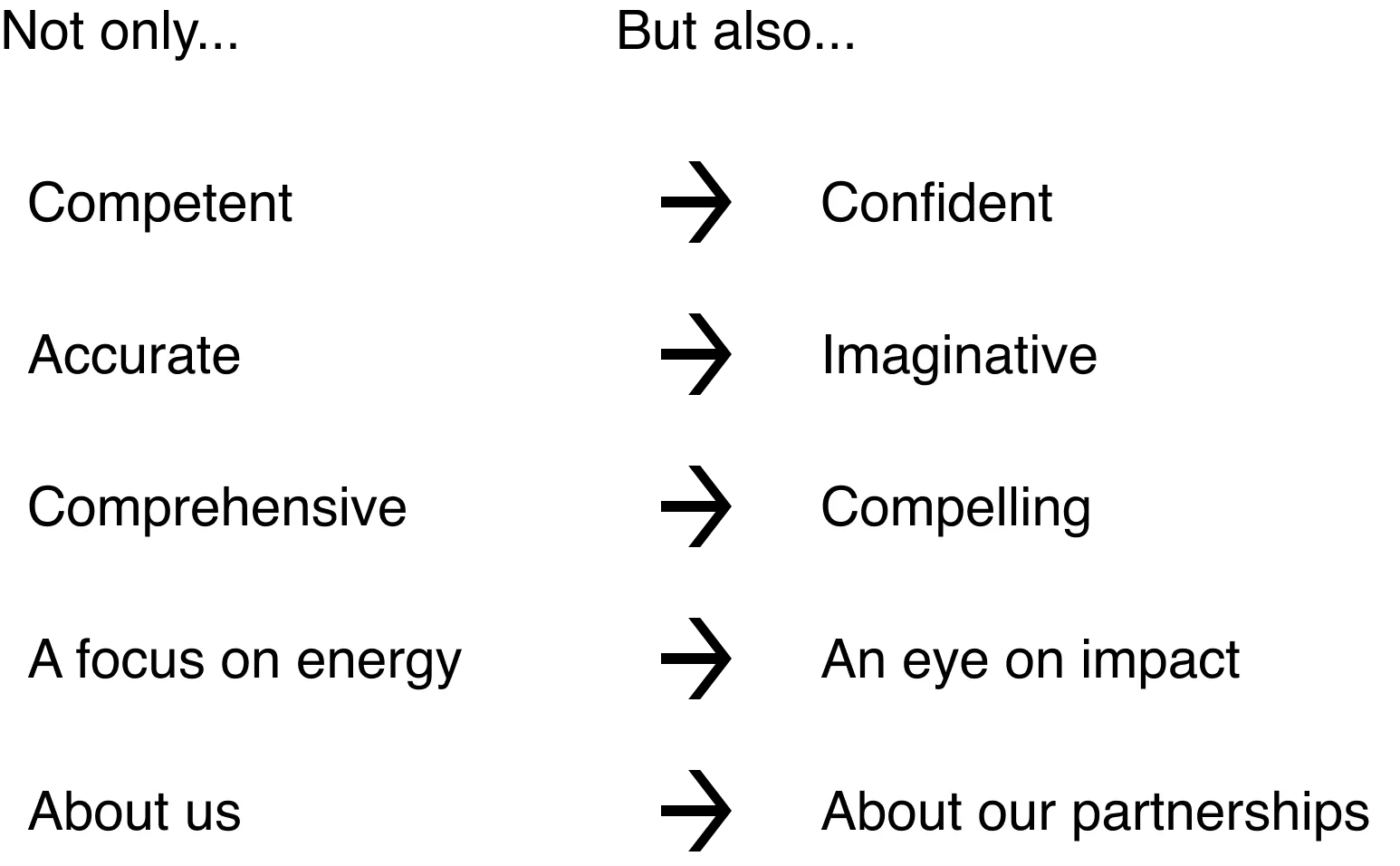
To do so, our tone of voice principles build on the values that inform all of our behavior at AES.
One of our values is:
Safety first
So our tone is always:
Simple
Fundamentally, we make it as easy as possible for everyone to understand us.
To do so, we use clear language and concise structures to make sure all our audiences can understand us with confidence.
One of our values is:
Highest standards
So our tone is always:
Aspiring
We are accurate about our work today, but ambitious about our impact tomorrow.
To maintain our humility, we use confident language but ground it in our honest assessments of what our future impact might be.
One of our values is:
All together
So our tone is always:
Inclusive
We rarely tell stories about ourselves alone. We celebrate partnership whenever we can.
To give others a role to play in our stories, we greet our readers, thank our partners, and cite others whenever possible.
Active voice vs passive voice
Use active voice. Avoid passive voice. In active voice, the subject of the sentence does the action. In passive voice, the subject of the sentence has the action done to it.
Words like “was” and “by” may indicate that you’re writing in passive voice. Scan for these words and rework sentences where they appear.
YES
- Newsweek interviewed Tish Mendoza.
- Marti logged into her Clean Energy Navigator account.
NO
- Tish Mendoza was interviewed by Newsweek.
- The Clean Energy Navigator account was logged into by Marti.
Write positively
Use positive language rather than negative language. One way to detect negative language is to look for words like “can’t" and "don't".
YES
- Please RSVP to attend the event.
- You must obtain prior approval to travel internationally.
NO
- Do not show up to the event without submitting an RSVP.
- You cannot travel internationally without prior approval.
Write simply
The simpler, the better. As a rule of thumb, you should aim to write at a Grade 8 (or age 14) reading level.
Even if your audience is technically-minded, people prefer to read less mentally demanding content and use less brainpower when given the option.
There are many free tools available to help you check the readability of your content.
Checking readability in Microsoft Word
Mac users: Go to Word > Preferences > Spelling and Grammar > Click “Show readability statistics” box.
PC users: Go to File > Options > Proofing > Click “Show readability statistics” box.
Once you’ve turned it on, every time you run spelling and grammar check, you’ll get a box with lots of information about your copy.
Our company's legal entity name is "The AES Corporation." Use "The AES Corporation" only when writing legal documents, contracts and the like. Otherwise, simply use "AES."
When referring to AES as an entity, we use personifying language to help foster a more human and informal connection. We use first person plural pronouns (e.g. we, us, our) and third-person plural pronouns (e.g. their, them).
Refer to AES and our businesses around the world as “our” and "we" not “it.”
YES
- AES and our partners.
NO
- AES and its partners.
You will generally only see AES use the singular pronoun (i.e. it) in formal communications, such as legal documents and press releases.
Personifying language examples
YES
- The AES Dominicana team dedicated their time to a community project
NO
- The AES Dominicana team dedicated its time to a community project
YES
- AES is a Fortune 500 global energy company. Our team of diverse people...
NO
- AES is a Fortune 500 global energy company. Its team of diverse people…
YES
- AES and our businesses around the world.
NO
- AES and its businesses around the world.
YES
- At AES Brasil, one of our business strategy pillars is responsibility, which involves investing in the local communities where we operate.
NO
- At AES Brasil, one of its business strategy pillars is responsibility, which involves investing in the local communities where it operates.
YES
- "I’m excited to invite you to participate in our fourth annual survey. AES is a Fortune 500 global energy company improving lives by delivering the greener, smarter energy solutions the world needs. You can learn more about how we became the leader in renewable energy and the clean energy transition here."
NO
- "I am a Director at AES. AES is a Fortune 500 global power company that provides affordable, sustainable energy to its customers in 14 countries. This year, the company is conducting its fourth annual survey."
- Outdated company description.
- Distancing language by referring to AES as “the company”.
Address all of our readers and audiences in either the second person (you or your) or the first person (I, me, or my), depending on which is suitable and clearest for the situation.
Each form of address is recommended for the following contexts:
- Second person, "you" or "your": This conversational style is appropriate in most situations, as though the author or user interface is speaking directly to the user.
- First person, "I" or "my": In some cases, this form of address emphasizes the user's ownership of content or actions.
Do not address your audience in the third-person.
YES
- You can view open positions at aes.com/careers.
NO
- Job seekers can view open positions at aes.com/careers.
To build AES as a customer-centric solutions provider, our brands are organized under a masterbrand model. The AES masterbrand extends across a selection of local markets that indicate AES’ local expertise and impact in our regions, as well as a selection of capabilities that include everything AES has to offer.
Architecture
Brand architecture is an external representation of what we offer. It helps our stakeholders navigate what they need from us. While it is not an internal organizational chart, it does inform how the brand is applied across all the different components of our business.
Our approach for brand architecture
To build AES as a customer-centric, solutions provider, our brands will be organized using a masterbrand model:
It’s centered on an AES masterbrand that we know has the social and commercial permission to offer solutions tailored to customer needs.
The AES masterbrand extends across a selection of local markets that indicate AES’ local expertise and impact in our regions …
… as well as a selection of capabilities that include everything AES has to offer.

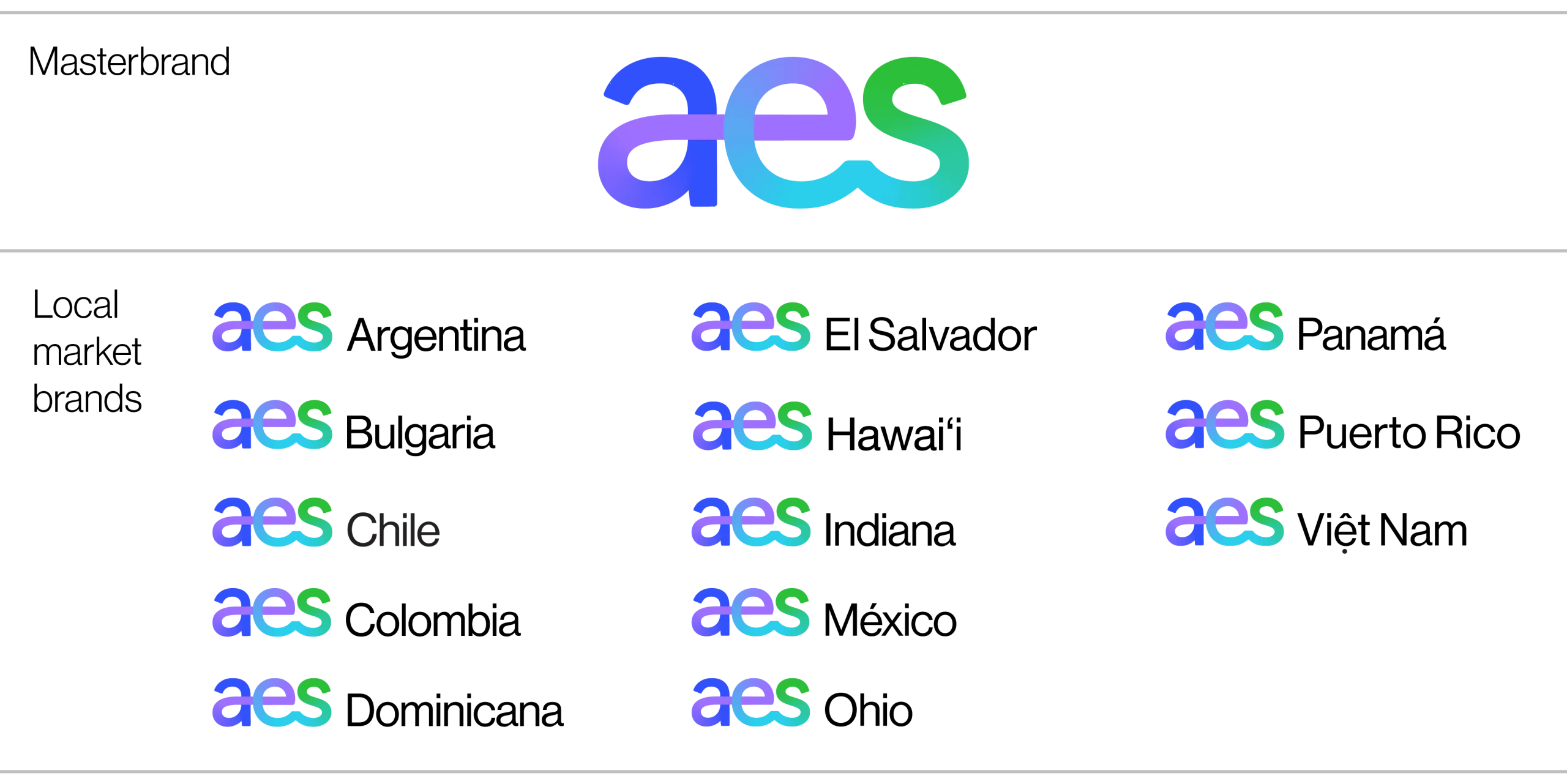
This model means that going forward, only the following are managed as brands:
Masterbrand
The AES brand is the main face that goes to the world and the brand that brings our organization together.
Use this brand to:
- Set strategic direction for the global organization
- Unify the business operationally and culturally as one company
- Maintain multi-market customer relationships
- Represent the employer for our people and contractors across markets
Local market brands
To leverage our global x local advantage, our local market brands are how we show up in the places we operate.
Use this brand to:
Communicate with local external stakeholders
- Launch local programs, initiatives, and projects
- Represent the plants, sites, and assets within a market
- Form local, market-specific partnerships and / or joint ventures
Exceptions
We will maintain certain brands beyond either master or local. These exceptions must be pre- approved before usage.
Use this brand to:
- Communicate externally as an entity with pre-existing equity, especially in a local market
- Elevate unique and differentiating value that can only be conveyed with a distinct name
In addition, this model means the following will no longer be managed as brands and will not have logos, wordmarks, or lockups with AES logos:
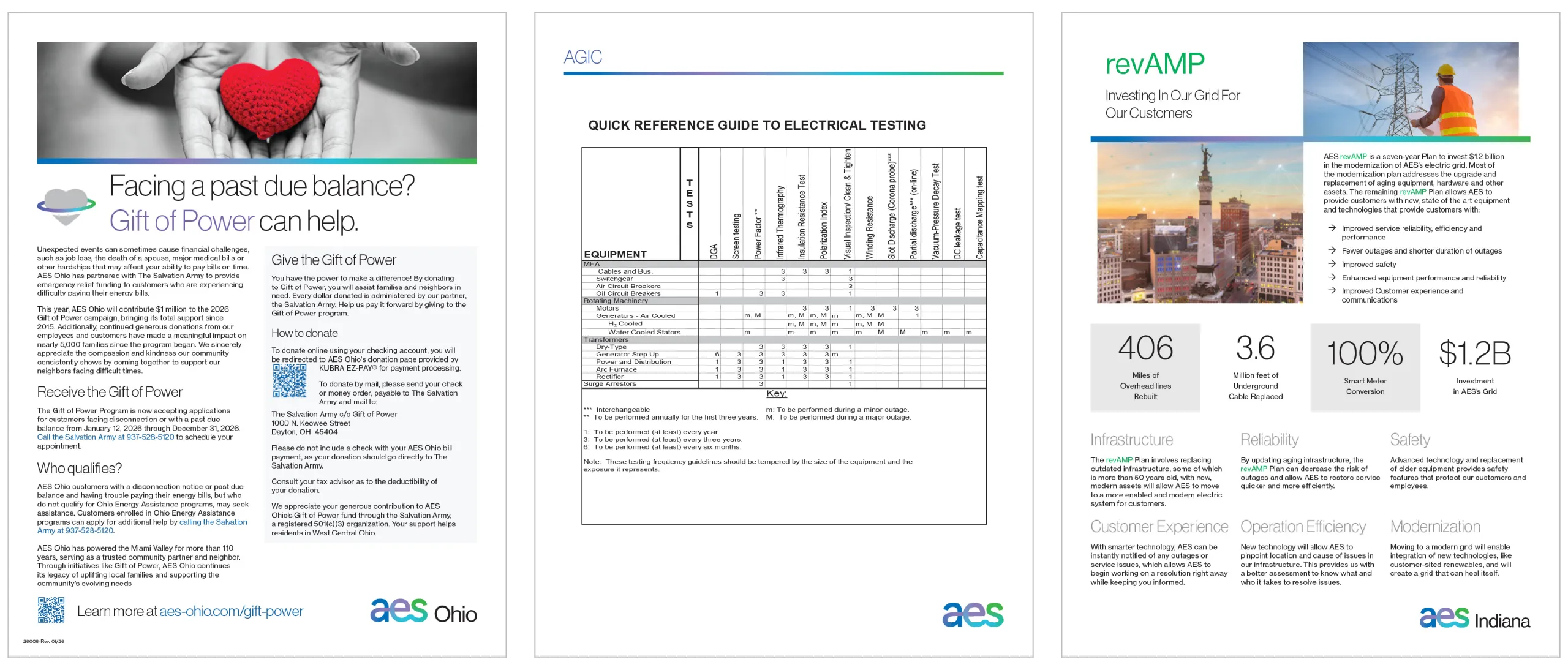
Anything not managed as a brand will use our "Program Treatment"
AES' Program Treatment uses a text only approach. Program names should be written in text only, kept separate from AES brand logos and use one of AES' Signature Colors to add emphasis.
The architecture of the masterbrand model is especially important for referring to AES businesses, plants and projects.
The previous formatting of “AES [plant name]”, such as AES Warrior Run or AES Mountain View, are now incorrect and cannot be used.
The correct formatting is now “[AES market name] + “[plant name] + “[descriptor].”
YES
- AES Panamá's Colón facility.
- AES Panamá's Colón plant.
- AES Panamá's Colón team.
NO
- AES Colón .
- AES Panamá Colón .
- The AES Panamá Colón plant.
After AES' ownership of a project is established through this format, it is acceptable in subsequent mentions of the project to use the project name using the format: "[plant name] + [descriptor]".
YES
- AES Panamá's Colón facility was the first LNG facility in Panama. The Colón plant began operations in 2018.
NO
- The Colón LNG plant was the first LNG facility in Panama. Colón began operations in 2018.
How to refer to team names within a market, externally and internally.
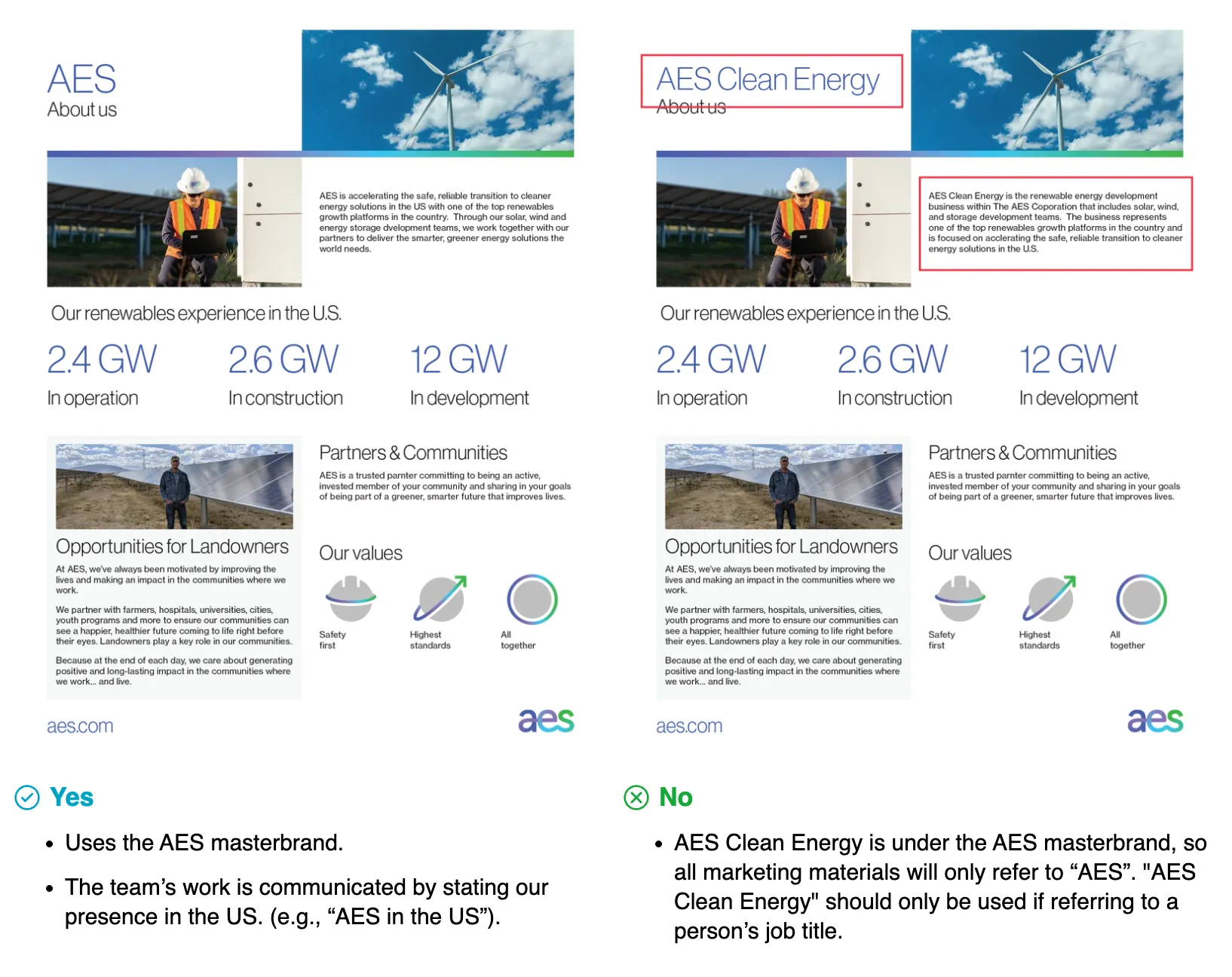
For both internal and external communications – including referring to projects, marketing materials, sales decks, press releases, and any other communications – the AES masterbrand model must be followed.
For teams that are under the AES masterbrand (e.g. AES Clean Energy) instead of a local market brand (e.g. AES Brasil), the only instance where it is acceptable to use the team name is in job titles or in legal documents as appropriate (e.g. AES Clean Energy Services, LLC).
YES
- Kleber Costa, AES Clean Energy Chief Commercial Officer
- AES’ PMRF microgrid
- AES donated to the United Way of California
- AES organized a blood drive at their office in Salt Lake City
NO
- Kleber Costa, AES Chief Commercial Officer
- AES Clean Energy’s PMRF microgrid
- AES Clean Energy donated to the United Way of California
- AES Clean Energy organized a blood drive at their office in Salt Lake City
How to write stories about customers, partnerships, and energy projects
Stories should focus on the customer, impact, and outcomes as opposed to assets, MW size, or financing amounts.
We show how we partnered together with our customers, highlighting our customer’s ambitious goals, industry leadership, and unique expertise paired with AES’ unique expertise and leadership, innovative spirit, and ability to co-create and deliver the best solution they needed to meet their goals.
Stories should
- Be written in AES’ tone of voice – simple, aspiring, and inclusive
- Highlight the customer
- Focus on impact and outcomes
- Show how AES is a true partner by collaborating, co-creating and providing insight to our customers
- Emphasize that AES is the source of the partnership and positive impacts delivered to the customer as opposed to a particular project
Stories should not
- Be difficult to read or alienate our audiences
- Focus on AES first and the customer second
- Focus on assets, MW size, financing amounts, location and the like
- Sound like AES is a transactional entity as opposed to a collaborative partner
- Imply that a project is the source of the positive impact or benefits when the reality is AES is providing benefits through a project
It’s OK to say that we developed the largest solar project in Puerto Rico or completed a $50 million debt financing. However, the focus of the story should be on the impact of the project.
How to write a story focused on impact and outcomes
Frame your story by asking “So what?”
Questions to ask and answer
- Why does the project matter?
- Additionally: Why does the size of the project matter? Why does the size of the financing matter?
- What challenges or pain points are we meeting for stakeholders?
- How does the project advance sustainability goals for our stakeholders?
- What impact does it have on our customer’s business goals or other goals?
- How is it positively impacting the community?
- How did AES provide unique value or insight to our customers? How did we collaborate or co-create a solution together?
Consider adding sentences like “The project will…” to describe the specific impacts it will make or outcomes and benefits it will deliver.
Establish the project’s connection to AES
Project summaries and stories do not need to include a reference to AES in every sentence. However, the project’s connection to AES should be established and reinforced. When AES is excluded, it makes it seem like the project is providing the benefits to stakeholders as an independent and agnostic entity as opposed to AES providing the benefits to our stakeholders through the project.
Example: Project stories
Spotsylvania solar project
YES
Through AES’ Spotsylvania solar project, we are generating more than 700 new jobs during the construction phase and approximately 20–25 full-time equivalent, permanent positions during operations. Over the lifetime of the project, we will generate approximately $8.4 million in tax revenue that will fund numerous county services, including education, emergency response, and local infrastructure.
- Establishes AES as the entity delivering benefits.
NO
The Spotsylvania solar project (Spotsylvania) is generating more than 700 new jobs during the construction phase and approximately 20–25 full-time equivalent, permanent positions during operations. Over the life of the project, Spotsylvania will generate approximately $8.4 million in tax revenue. The stable tax revenue generated by this project will fund county services including education, emergency response, and local infrastructure.
- Positions the Spotsylvania project as the entity delivering benefits instead of AES.
Mountain View wind farm
YES
AES is excited to celebrate the successful repowering of our Mountain View wind facility in Southern California. The repowered 67 MW facility features the most advanced wind technology that enables the generation of more clean energy with fewer wind turbines while benefiting the local economy. Clean energy generated from the repowered Mountain View Wind facility will go to Central Coast Community Energy and Silicon Valley Clean Energy to meet the clean energy needs of the California communities they serve. We are proud to help California fight climate change and meet its mandate to be powered by 100% renewables by 2045.
NO
AES is excited to celebrate the repowering of the 67 MW Mountain View wind farm in Southern California. Located in Riverside, California, the facility is comprised of 14 turbines standing at 412 ft tall each.
- Without an impact statement, the information about project location and wind turbine height don't provide value to the story.
Community solar
YES
New York, Massachusetts, and Illinois needed a reliable, accessible and affordable solution within their communities to achieve each of the states’ ambitious sustainability goals. We provided a 215 MW portfolio of community solar projects, providing clean energy access to schools, utilities, municipalities and businesses across the local communities.
- Highlights both the challenge our customers faced and the impact of our solution to show why it’s the best fit for them.
Not bad, but not great
AES recently financed 30 community solar projects that will provide reliable and cost-effective renewable energy solutions to utilities, municipalities, schools, and corporate customers throughout New York, Massachusetts, and Illinois.
- Includes a brief impact statement, but the tone is transactional.
NO
AES recently financed 30 community solar projects to utilities, municipalities, schools, and corporate customers throughout New York, Massachusetts, and Illinois.
- Doesn’t include the positive impact.
- Tone is transactional as opposed to partnership-oriented.
Microsoft
YES
When Microsoft needed a partner to meet its commitment to transform its operations and create a cleaner cloud, they put their trust in AES. Through the partnership, Microsoft purchased 315 MW of solar energy from our portfolio in Virginia, representing the single largest corporate purchase of solar energy in the United States at the time.
- By sharing the challenge Microsoft faced, we add context to why the scale of the portfolio matters as well as showing the magnitude of trust placed in AES as a partner.
NO
In 2019, Microsoft was looking to procure a significant amount of renewable energy to meets its sustainability targets. Through a competitive selection process, they selected AES to provide 315 MW of solar energy.
- Sounds like a transaction between AES and Microsoft as opposed to a partnership.
Alamitos energy storage project
YES
AES’ Alamitos Battery Energy Storage System (BESS) in California made history as the world’s first stand-alone energy storage project for local capacity, the first time an energy storage system was specifically procured instead of a new natural gas peaking plant in the United States, and the world’s first grid-scale energy storage system to receive a long-term PPA. Through these unprecedented achievements, the Alamitos BESS, a 100 MW / 400 MWh storage system and one of the world’s largest energy storage systems in operation today, ushered in widespread domestic and global adoption of energy storage and demonstrated energy storage as a critical component of the world’s energy future.
- States each of the achievements and describes the positive impact these achievements made locally and globally.
NO
AES’ Alamitos Battery Energy Storage System (BESS) is a 100 MW standalone energy storage facility that is serving Southern California Edison customers. At the time of the agreement, the facility was the largest standalone energy storage system in the United States.
- While factually accurate, this project summary does not speak to the impact of the project or why its achievement as the largest standalone energy storage system matters.
PMRF microgrid
YES
Energy reliability, security, and resiliency are critical for KIUC and the US Navy. Together, we co-created a first-of-its-kind clean energy microgrid located on the US Navy’s land, which also supports KIUC’s local grid during everyday operation.
- Clearly states the challenge at hand.
- This version more clearly communicates how the solution benefits both partners by naming KIUC.
- Uses partnership-oriented language, such as editing “feed the local grid” to “supports KIUC’s local grid”.
NO
AES began working with KIUC and the U.S. Navy to address the desire of energy reliability and resiliency through renewable energy. The result was a microgrid design for a solar plus battery energy storage system sited on the US Navy land which during typical operation will feed the local grid.
- This version could do a better job of showing AES’ insight that led us to develop a better solution and highlighting our ability to co-create these solutions with our customers.
- The use of the word “result” distances and downplays AES’ role in developing the solution.
Our history
YES
We built AES to find better ways of serving the energy sector. Throughout our history, we’ve connected proven technologies with innovative commercial models to bring dependable, cost-effective energy to more people. With inspiration from outside industries, we’re able to apply proven solutions and rethink how we approach system challenges. By changing the context and shifting our vantage point, we can reimagine our approach to everything we do and continually improve the way we work with our customers, communities, and partners.
NO
We built and grew AES through finding better ways to serve the power sector. Throughout our history this has meant applying proven technologies and innovating commercial models to bring dependable, cost-effective power to utilities and their customers. We call our approach applied innovation. AES aligns acute system problems with a proven solution, typically borrowed from outside of our industry, which changes the context of the marketplace so that new approaches can effectively improve and grow.
Financing examples
YES
AES Dominicana and Scotiabank signed a financing agreement for US $36 million over five years for the construction of the Santanasol solar project. The solar plant is part of AES Dominicana's sustainability strategy to reduce their environmental footprint. The 50 MW project is expected to reduce 90,000 tons of CO2 each year and will directly support 30,000 homes in the province of Peravia, located in the south of the country.
- Shows how the financing ties to our renewable energy strategy and the positive impact the financing will have in creating positive climate and community impacts.
NO
AES Dominicana and Scotiabank signed a financing agreement for US $36 million over five years for the construction of the Santanasol solar project. The contract was signed by Edwin De los Santos, Market Business Leader of AES Dominicana, and Gonzalo Parral, Executive President of Scotiabank in the Dominican Republic. The project will be developed in the province of Peravia, in the south of the country.
- Focuses on the amount of the financing, but it does not describe the positive impact the financing will have or why it matters.
YES
AES announced the closing of a landmark $154 million debt financing for the Luna storage project, a 400 MWh standalone battery storage facility California. Closing this landmark debt financing deal underscores the advancements of standalone battery storage technology to help the state transition to a reliable, carbon-free grid. Through the project, AES will enable Clean Power Alliance to cost effectively integrate intermittent renewable energy resources into the grid, providing more reliability for their customers at a fixed price.
- Explains the impact of the “landmark” financial deal.
- Emphasizes that AES is the entity providing benefits to our partner, Clean Power Alliance.
NO
AES announced the closing of a landmark $154 million financing for the Luna storage project, a 400 MWh standalone lithium-ion battery storage facility, California. The Luna storage project will be one of the largest battery facilities in Clean Power Alliance’s portfolio.
- States interesting facts (e.g. landmark financing, one of the largest battery facilities) but does not explain the impact.
Including project location information
When sharing the location of a project in the US, the state and/or city is sufficient. When sharing the location of a project outside of the US, the city and country is sufficient. This is because when describing a project or telling a story, excessive location information detracts from the purpose of what we’re aiming to communicate: the positive impact and outcomes. When writing about locations, the goal should be to provide a quick context as needed.
Utah
YES
- The 10 MW solar project, located in West Valley City, Utah, will deliver clean energy to the local community.
- The 10 MW solar project is located in West Valley City, Utah, near AES’ US headquarters in Salt Lake City.
NO
- The solar project is located in West Valley City, Utah. It will provide 10 MW of clean energy to the local community.
The location is the least interesting part of the story. If the location needs to be included, it should be tied to the impact the project is making and/or moved to the end of the summary.
El Salvador
YES
- AES El Salvador inaugurated a new public electric vehicle charging station located in in San Salvador.
- AES El Salvador inaugurated a new public electric vehicle charging station located in the Layco neighborhood, San Salvador.
Brazil
YES
AES Brasil revitalized the Maria José Aras Municipal Child Education Unit, located in the state of Bahia, where AES Brasil is building the Tucano wind complex. AES Brasil and Unipar, one of the venture partners for the Tucano wind complex, unveiled the newly renovated playroom, classroom and dining room to the public. Improvements also included the donation of furniture, toys, books, and costumes. The 205 children who attend the school will now have more educational spaces to contribute to their development.
- Tying the location of the Education Unit to where AES Brasil is building a wind project shows how we invest in the communities where we work.
- Describes the positive impact the revitalization of the center will have on the children who use it.
NO
AES Brasil revitalized the Maria José Aras Municipal Child Education Unit, located in A Coruñ, state of Bahia, Brazil, in the west of the country.
- These multiple pieces of location information do not provide value to the story. The story should focus on why we revitalized the center and the impact we are making through it.
How to write to customers
We are both uniquely differentiated from our competitors and uniquely able to deliver what our customers want in a partner. Our propositions, or what we offer, to our customers reflect our core differentiators and help inform our talking points when we interact with them.
The communications methods and statements included in this section will help you to effectively tell stories, write communications, and create content for your customers.
Propositions and messages to customers
AES is an innovative and reliable partner combining its global resources and local expertise to deliver greener, smarter energy solutions that work for you and your priorities, to accelerate your future and to improve lives.
Our proof points: to customers
- AES is a true partner that can enable you to deliver on your business goals.
- There is an urgent need for businesses to be part of a greener energy ecosystem, and you have the power to develop the best solution for your business.
- We have experience creating tailored solutions, from large infrastructure to local distributed generation, and have integrated advanced technologies in digital.
- We work with you to understand your immediate pain points and long-term objectives.
- We combine our global resources with local expertise to deliver world-class solutions to you.
- Together, we co-create your unique solution and always apply our innovations to your specific needs.
- We’ve always been motivated by improving lives, seeking to make a lasting impact wherever we operate.
- Set yourself up to win with greener, smarter energy solutions with AES.
Our message: to customers
- Customer stories of shared goal-setting.
- Customer transformation stories (e.g. Green Blend & Extend, LNG).
- Customer project milestones.
- Renewables goals and storage fleet statistics.
- Applied innovation stories.
- Customer and industry recognition and awards
For additional messaging to specific stakeholder groups – such as prospective talent, communities, investors, and more, visit AES' verbal identity guidelines
How to write about awards and recognitions
The same focus on impact applies to how we write about awards and recognitions we receive.
The story should go beyond stating “AES won [award name]” and explain:
- What the award is.
- The impact the award is recognizing.
Items to consider
- Describe what the award is and why it matters.
- Explain the evaluation criteria.
- Share how the award aligns to our strategy, goals, and values, or how we work as a company.
Examples
YES
AES Panamá received the “Corporate Excellence Award” from the US Department of State. AES Panamá was recognized for Sustainable Energy Security for creating the first natural gas plant and reception terminal in Central America, a core energy hub for the region designed to meet growing energy demands using a cleaner, resilient supply.
- With the insertion of "for creating", this summary explains why AES Panamá received the award in terms of the need the team met and the impact made through the solution.
NO
AES Panamá received the “Corporate Excellence Award” from the US Department of State. The award was presented by the Chargé d’Affaires at the United States Embassy in Panamá, Stewart Tuttle. Accepting the award were AES' Juan Ignacio Rubiolo and Miguel Bolinaga. We’re proud to receive this prestigious honor.
- States who attended the award ceremony but doesn't explain what the award is, why AES Panamá won the award or why the recognition matters.
YES
AES Panamá received the “Palma de Oro 2021” award from the Sindicato de Industriales de Panamá for their "Condensed water recovery” project. The project aims to recover condensed water from the plant's regasification process. Within five months, the project had recovered enough water to fill 3.5 Olympic-size swimming pools, reduced the cost of using chemicals in the treatment plant and reduced the consumption of seawater. It is projected to save more than US $160,000 per year.
- Focuses on summarizing the team's goal with the project and impact for which they received the award.
NO
AES Panamá received the “Palma de Oro 2021” award from the Sindicato de Industriales de Panamá for their "Condensed water recovery” project. The project aims to recover condensed water from the plant's regasification process.
- Briefly states the project's goal, but does not cover the challenge at hand or the project's effectiveness or impact.
YES
AES' Alamitos BESS was just awarded the “Best Project of the Year: Energy / Industrial” by Engineering News-Record! The team pulled off the ambitious task to bring the world’s first battery storage system for local capacity to life and set the standard for developing safe, efficient buildings for energy storage.
- Succinctly covers the award name, why the team won and the impact of the project.
NO
AES' Alamitos BESS was just awarded the “Best Project of the Year: Energy / Industrial” by Engineering News-Record! The project is one of the largest standalone battery storage facilities in the world.
- States an interesting fact that the project is one of the largest standalone storage facilities in the world, but it also needs to cover the importance and impact of the project.
About AES boilerplate
The most up to date AES boilerplate can be found by viewing the most recent press release on our website.
The AES Corporation (NYSE: AES) is a Fortune 500 global energy company accelerating the future of energy. Together with our many stakeholders, we're improving lives by delivering the greener, smarter energy solutions the world needs. Our diverse workforce is committed to continuous innovation and operational excellence, while partnering with our customers on their strategic energy transitions and continuing to meet their energy needs today. For more information, visit www.aes.com.
Businesses under the AES masterbrand
For businesses and teams that are under the AES masterbrand (e.g. AES Clean Energy) instead of a local market brand (e.g. AES Brasil), all press releases will be issued from The AES Corporation.
YES
- The AES Corporation (NYSE: AES) and Air Products (NYSE: APD) today announced plans to invest approximately $4 billion to build a green hydrogen production facility in Texas.
NO
- AES Clean Energy and Air Products (NYSE: APD) today announced plans to invest approximately $4 billion to build a green hydrogen production facility in Texas.
- AES Clean Energy, the US clean energy business of The AES Corporation (NYSE: AES), and Air Products (NYSE: APD) today announced plans to invest approximately $4 billion to build a green hydrogen production facility in Texas.
Job titles in press releases
When introducing AES people and their titles in press releases, use the following format:
"[Name of person] , + [Market name] + [Title]"
YES
- "AES is proud to support Amazon's bold actions to power its business operations with 100% renewable energy," said Andrés Gluski, AES President and CEO.
NO
- AES is proud to support Amazon's bold actions to power its business operations with 100% renewable energy," said President and CEO, AES, Andrés Gluski.
- AES is proud to support Amazon's bold actions to power its business operations with 100% renewable energy," said AES President and CEO Andrés Gluski.
YES
- Andrés Gluski, AES President and CEO, was named Chairman of the American Society Council of Americas.
NO
- Andrés Gluski, President and CEO, AES, was named Chairman of the American Society Council of Americas.
- President and CEO, AES, Andrés Gluski, was named Chairman of the American Society Council of Americas.
All additional instances referring to a person that has been introduced should only use the person’s first name.
YES
- Andrés Gluski, AES President and CEO, was named Chairman of the American Society Council of Americas. Andrés has been a committed member to the organization for many years.
NO
- Andrés Gluski, AES President and CEO, was named Chairman of the American Society Council of Americas. Gluski has been a committed member to the organization for many years.
For teams that are under the AES masterbrand (e.g. AES Clean Energy) instead of a local market brand (e.g. AES Brasil), the only instance where it is acceptable to use the team name within a press release is in job titles.
YES
- Kleber Costa, AES Clean Energy Chief Commercial Officer
NO
- Kleber Costa, AES Chief Commercial Officer
Text should be understandable by anyone, anywhere, regardless of their culture or language. We write for a diverse audience of readers who all interact with our content in different ways. We aim to make our content accessible to anyone using a screen reader, keyboard navigation, or Braille interface, and to users of all cognitive capabilities.
As you write, consider the following:
- Would this language make sense to someone who doesn’t work here?
- Could someone quickly scan this document and understand the material?
- If someone can’t see the colors, images or video, is the message still clear?
- Is the markup clean and structured?
- Does this work well on mobile devices?
Avoid directional language
Avoid directional instructions and any language that requires the reader to see the layout or design of the page. This is helpful for many reasons, including layout changes on mobile.
YES
- “Select from these options” (Followed by the steps listed after the title).
NO
- “Select from the options in the right sidebar.”
Use plain language
Write short sentences and use familiar words. Avoid jargon and slang. If you need to use an abbreviation or acronym that people may not understand, explain what it means on first reference.
Make sure closed captioning is available
Closed captioning or transcripts should be available for all videos. The information presented in videos should also be available in other formats.
Use headers
Headers should always be nested and consecutive. Never skip a header level for styling reasons. To help group sections, be sure the page title is H1, top-level sections are H2s, and subsequent sections inside those are H3 and beyond. Avoid excessive nesting.
Include a descriptive call-to-action
Links should provide information on the associated action or destination.